
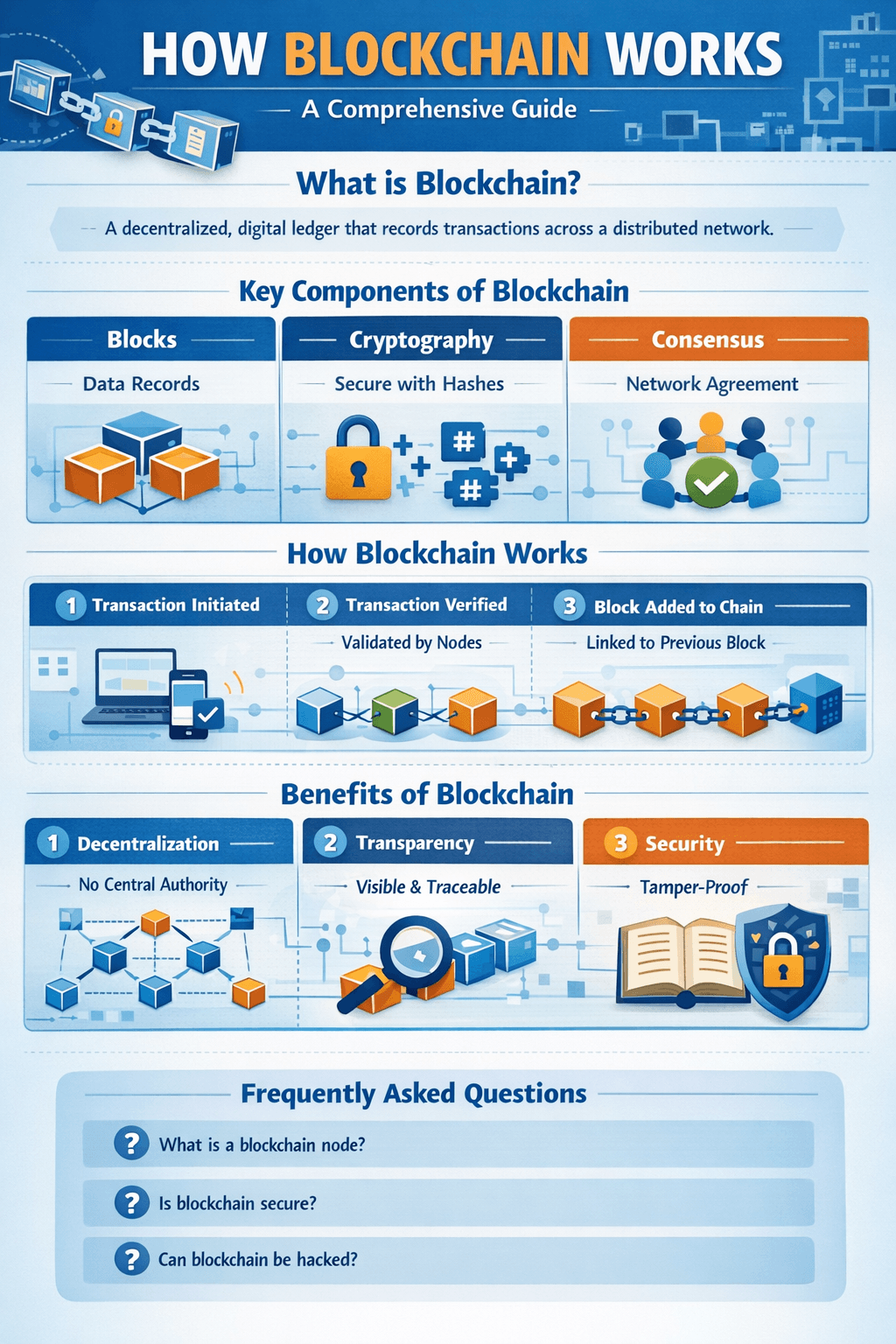
How Blockchain Works: A Complete Guide
Blockchain technology has become one of the most revolutionary innovations of the digital age. From powering cryptocurrencies like Bitcoin to transforming industries such as finance, healthcare, and supply chain, blockchain is reshaping how data is stored and shared.
In this guide, we will break down how blockchain works in a simple, step-by-step way while also covering advanced concepts for deeper understanding.
What is Blockchain?
At its core, a blockchain is a distributed digital ledger that records transactions across multiple computers. Unlike traditional databases controlled by a central authority, blockchain operates in a decentralized manner.
Each record in a blockchain is called a "block," and these blocks are linked together in a chronological "chain." Once data is added, it becomes extremely difficult to modify or delete, ensuring transparency and security.
Key Features of Blockchain
1. Decentralization
Blockchain does not rely on a single central authority. Instead, it is maintained by a network of nodes (computers), making it more secure and resistant to failures.
2. Transparency
All transactions are visible to participants in the network. This builds trust among users since data cannot be hidden.
3. Immutability
Once data is recorded, it cannot be changed easily. This prevents fraud and tampering.
4. Security
Blockchain uses cryptographic techniques to secure data, making it highly resistant to hacking.
How Blockchain Works (Step-by-Step)
Let’s understand the complete process:
Step 1: Transaction Initiation
A user initiates a transaction, such as sending cryptocurrency or recording data.
Step 2: Transaction Broadcast
The transaction is broadcast to a network of computers (nodes).
Step 3: Validation
Nodes validate the transaction using predefined rules and consensus mechanisms.
Step 4: Block Creation
Once validated, the transaction is grouped with other transactions to form a block.
Step 5: Block Hashing
Each block gets a unique cryptographic hash and includes the hash of the previous block.
Step 6: Adding to Blockchain
The block is added to the chain, making it permanent and immutable.
What is a Block?
A block consists of:
- Transaction data
- Timestamp
- Previous block hash
- Current block hash
This structure ensures that each block is securely linked to the previous one.
What is Hashing?
Hashing is a process that converts data into a fixed-length string using algorithms like SHA-256. Even a small change in input creates a completely different hash.
This ensures data integrity and security within the blockchain.
Consensus Mechanisms
Consensus mechanisms ensure all nodes agree on the blockchain’s state.
1. Proof of Work (PoW)
Used by Bitcoin, it requires solving complex mathematical problems.
2. Proof of Stake (PoS)
Validators are chosen based on the number of coins they hold.
3. Delegated Proof of Stake (DPoS)
Users vote for delegates who validate transactions.
Mining in Blockchain
Mining is the process of validating transactions and adding new blocks. Miners compete to solve cryptographic puzzles, and the winner gets rewards.
Types of Blockchain
1. Public Blockchain
Open to everyone (e.g., Bitcoin, Ethereum).
2. Private Blockchain
Restricted access, used by organizations.
3. Consortium Blockchain
Controlled by a group of organizations.
Real-World Use Cases
1. Cryptocurrency
Blockchain powers digital currencies like Bitcoin and Ethereum.
2. Supply Chain
Tracks products from origin to delivery.
3. Healthcare
Secure storage of patient records.
4. Finance
Faster and cheaper cross-border payments.
5. Voting Systems
Ensures transparent and tamper-proof elections.
Advantages of Blockchain
- Increased security
- Transparency
- Reduced costs
- Faster transactions
- Elimination of intermediaries
Disadvantages of Blockchain
- High energy consumption (PoW)
- Scalability issues
- Regulatory uncertainty
- Complex technology
Future of Blockchain
Blockchain is expected to play a major role in Web3, decentralized finance (DeFi), and digital identity systems. As technology evolves, scalability and efficiency will improve, making blockchain more widely adopted.
Conclusion
Blockchain is more than just a technology behind cryptocurrencies. It is a powerful system that ensures secure, transparent, and decentralized data management.
Understanding how blockchain works opens the door to exploring innovations like smart contracts, NFTs, and decentralized applications (dApps).
As industries continue to adopt blockchain, learning this technology today can provide a significant advantage for the future.
FAQs
1. Is blockchain only used for cryptocurrency?
No, blockchain is used in many industries beyond cryptocurrency.
2. Is blockchain secure?
Yes, it uses cryptographic techniques to ensure security.
3. Can blockchain be hacked?
It is extremely difficult but not impossible if implemented poorly.
4. What is the main purpose of blockchain?
To provide a decentralized and secure way to store and transfer data.
This blog is SEO-optimized and designed to rank well while providing real value to readers.