
Blockchain is often described as trustless, meaning you don’t need a central authority to verify transactions. But then the question arises:
👉 If there’s no central authority, who verifies the data?
The answer is Consensus Mechanisms.
Consensus mechanisms are the core engine of blockchain systems. They ensure that all nodes in a decentralized network agree on the same data.
Without consensus, blockchain would fail.
In this guide, you’ll learn:
- What consensus mechanisms are
- How they work
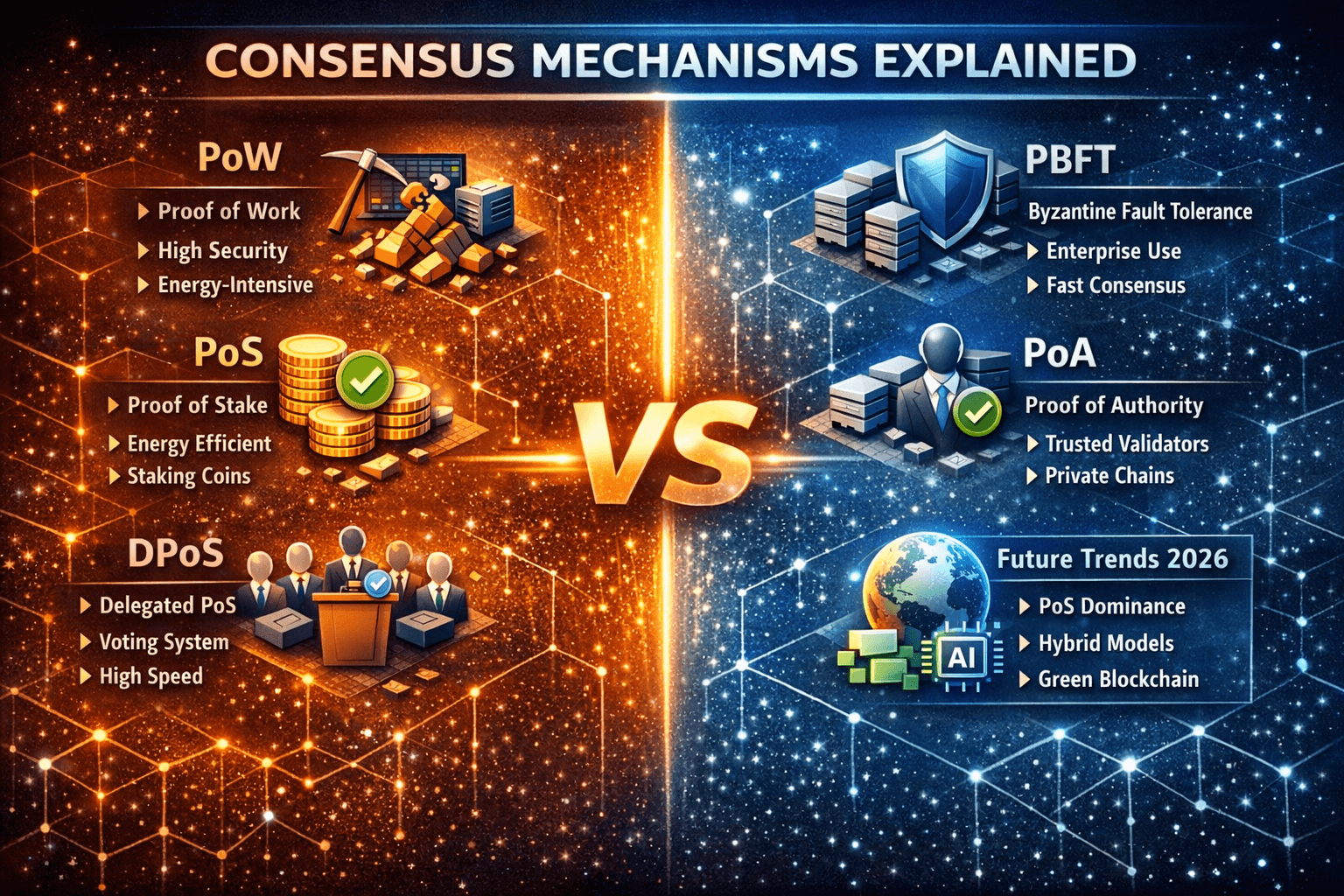
- Types like PoW, PoS, DPoS
- Real-world examples
- Which one is best
Alt Text: consensus mechanism blockchain visualization
🔗 What is a Consensus Mechanism?
A consensus mechanism is a process used in blockchain to validate transactions and maintain agreement across all nodes.
🔹 Simple Definition:
It’s a system that ensures everyone in the network agrees on one version of truth.
🔹 Why It’s Important:
- Prevents fraud
- Avoids double spending
- Maintains data integrity
- Enables decentralization
⚙️ How Consensus Works
- A transaction is created
- It is broadcast to the network
- Nodes validate the transaction
- Consensus algorithm decides validity
- Transaction is added to the blockchain
Alt Text: consensus process flow
🔑 Key Properties of Consensus Mechanisms
- Decentralization – No single authority
- Security – Resistant to attacks
- Fault Tolerance – Works even if some nodes fail
- Consistency – Same data across network
⚡ Types of Consensus Mechanisms
Let’s explore the most popular ones:
🔥 1. Proof of Work (PoW)
🔹 What is PoW?
Proof of Work is the first consensus mechanism, used by Bitcoin.
It requires miners to solve complex mathematical problems.
🔹 How It Works:
- Miners compete to solve puzzles
- First to solve gets reward
- Block is added to chain
🔹 Example:
Bitcoin
Alt Text: proof of work mining
✅ Advantages:
- Highly secure
- Proven technology
❌ Disadvantages:
- High energy consumption
- Slow transactions
⚡ 2. Proof of Stake (PoS)
🔹 What is PoS?
Instead of mining, validators stake coins to validate transactions.
🔹 How It Works:
- Users lock crypto (stake)
- Validators are chosen randomly
- They validate blocks
🔹 Example:
Ethereum 2.0
Alt Text: proof of stake system
✅ Advantages:
- Energy efficient
- Faster than PoW
❌ Disadvantages:
- Wealth concentration risk
🗳️ 3. Delegated Proof of Stake (DPoS)
🔹 What is DPoS?
Users vote for delegates who validate transactions.
🔹 How It Works:
- Token holders vote
- Selected delegates validate blocks
- Faster decision-making
🔹 Example:
EOS, TRON
Alt Text: delegated proof of stake
✅ Advantages:
- Very fast
- Scalable
❌ Disadvantages:
- Less decentralized
🔐 4. Practical Byzantine Fault Tolerance (PBFT)
🔹 What is PBFT?
Used in permissioned blockchains.
🔹 Features:
- Fast consensus
- Suitable for enterprises
🔹 Example:
Hyperledger Fabric
Alt Text: byzantine fault tolerance
⚡ 5. Proof of Authority (PoA)
🔹 What is PoA?
Validation is done by trusted nodes.
🔹 Example:
Private blockchains
Alt Text: consensus comparison
🔐 Security Comparison
- PoW → Most secure but expensive
- PoS → Balanced security
- DPoS → Faster but less secure
- PBFT → Secure for private networks
⚡ Performance & Scalability
- PoW → Low scalability
- PoS → Moderate scalability
- DPoS → High scalability
Alt Text: performance comparison
💰 Cost Analysis
- PoW → High cost (energy)
- PoS → Medium cost
- DPoS → Low cost
🌍 Real-World Use Cases
- Bitcoin → PoW
- Ethereum → PoS
- Binance Chain → PoA
- Hyperledger → PBFT
Alt Text: real world use cases
✅ Advantages of Consensus Mechanisms
- Decentralization
- Security
- Trustless transactions
- Transparency
❌ Disadvantages
- Complexity
- Energy consumption (PoW)
- Scalability challenges
🧭 When to Use Which?
- Use PoW → Maximum security
- Use PoS → Balanced performance
- Use DPoS → High speed apps
- Use PBFT/PoA → Enterprise systems
🔮 Future Trends (2026)
- Rise of Proof of Stake dominance
- Hybrid consensus models
- Green blockchain solutions
- AI + blockchain validation
Alt Text: future of consensus
🧾 Final Conclusion
Consensus mechanisms are the heart of blockchain technology.
👉 There is no “best” mechanism — only the right one for your use case.
- Want security? → PoW
- Want efficiency? → PoS
- Want speed? → DPoS
💡 Future systems will use hybrid consensus models
❓ FAQ
1. What is consensus in blockchain?
Agreement between nodes on transaction validity.
2. Which consensus is best?
Depends on use case.
3. Why is PoW slow?
Because of complex computations.
4. Is PoS better than PoW?
Yes for efficiency, but trade-offs exist.
5. What is the future of consensus?
Hybrid and energy-efficient systems.
🔗 Internal Links
- Blockchain vs Database
- What is Web3
- Smart Contracts Guide
🌐 External Links
- Ethereum.org
- Bitcoin Whitepaper
- Hyperledger Docs