Agentic AI Is Coming to Enterprise Software: What Does It Mean for Today’s Software Engineers?
By TechYantram Team | October 30, 2026
Artificial intelligence is no longer limited to chatbots, code suggestions, or content generation.
The next major shift is Agentic AI — AI systems that can understand a goal, create a plan, use software tools, execute multiple steps, evaluate results, and continue working with limited human intervention.
For enterprise software, this could fundamentally change how applications are built, tested, deployed, and maintained.
But there is an important question for developers:
If AI agents can write and modify software, what happens to software engineers?
The answer is not that developers disappear. Instead, the role of the software engineer is likely to move toward system design, architecture, decision-making, AI supervision, security, and business understanding.
What Is Agentic AI?
Traditional AI usually responds to an instruction.
For example:
"Write a REST API for user registration."
An AI coding assistant may generate the required code.
An agentic system goes further.
You could give an AI agent a goal such as:
"Build a complete user registration module with authentication, email verification, database integration, tests, documentation, and deployment configuration."
The agent can potentially break the requirement into smaller tasks, inspect an existing codebase, modify multiple files, run tests, identify failures, fix them, and prepare the result for human review.
That difference is significant.
Generative AI creates. Agentic AI acts.
From AI Copilot to AI Teammate
The first generation of AI developer tools primarily acted as copilots.
Developers remained responsible for:
- Understanding requirements
- Writing most of the code
- Running tests
- Debugging problems
- Reviewing pull requests
- Deploying applications
Agentic development changes this workflow.
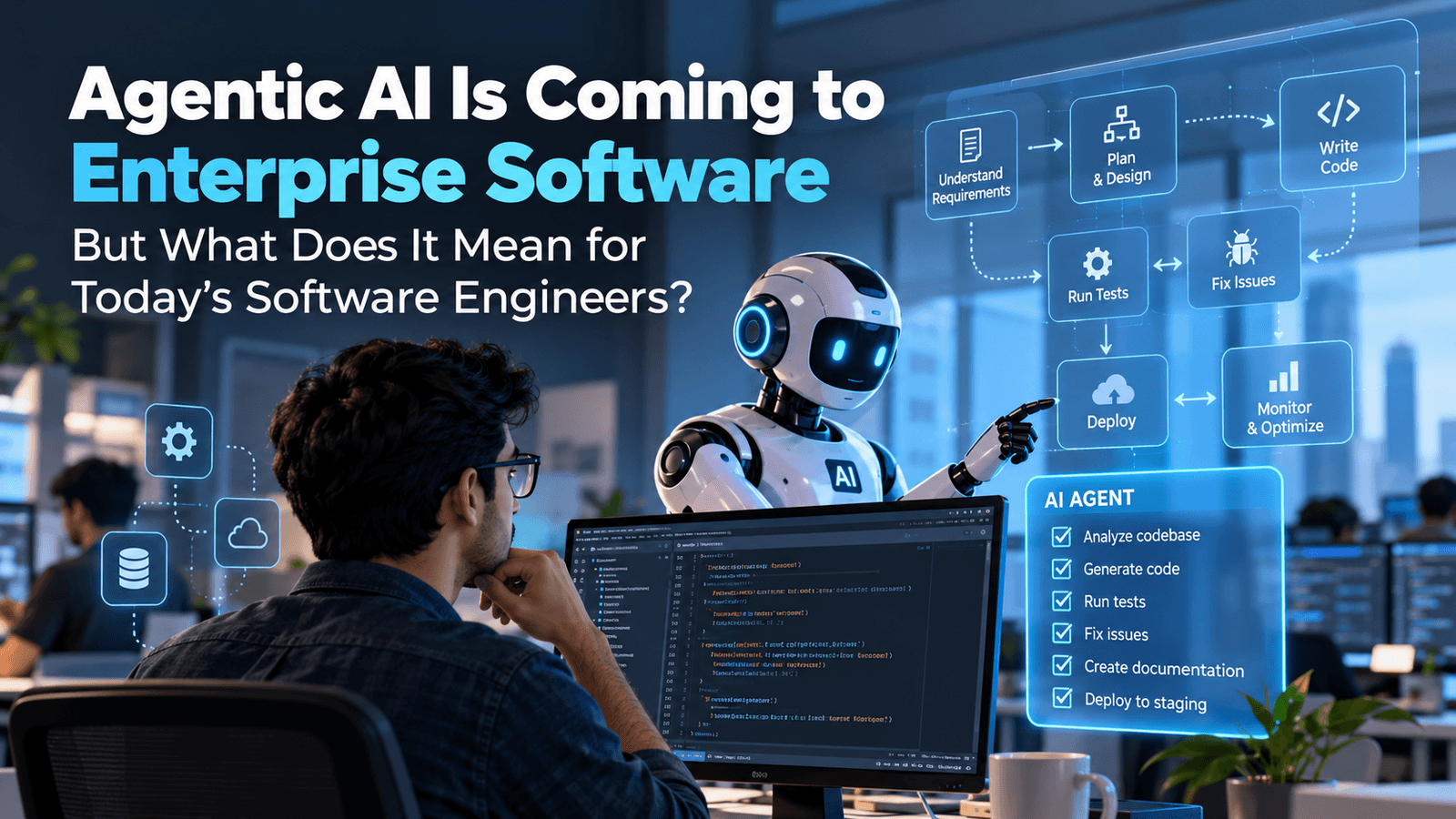
An AI agent can potentially participate in several stages of the software lifecycle:
Requirement → Planning → Architecture → Coding → Testing → Security → Review → Deployment → Monitoring
This is why enterprises are increasingly looking at AI agents as part of their software-development processes rather than simply treating them as coding assistants.
Research and industry analysis increasingly describe this shift as agentic engineering: engineers orchestrating, reviewing, and validating AI agents instead of manually producing every implementation detail.
So, Will AI Replace Software Engineers?
Probably not in the simple way people imagine.
Instead, AI is likely to replace portions of software-engineering work before it replaces software engineers themselves.
Consider the difference.
Tasks AI agents can increasingly handle
- Boilerplate code
- CRUD APIs
- Unit tests
- Documentation
- Code refactoring
- Bug investigation
- Database migrations
- Dependency updates
- Basic UI implementation
- Log analysis
- Code reviews
- CI/CD assistance
These tasks are often structured and can be verified through tests or predefined rules.
But many engineering decisions are much harder.
Tasks that still require strong human judgment
- What should actually be built?
- Which architecture is appropriate?
- What are the business risks?
- How should sensitive data be protected?
- What happens if an AI agent makes a wrong decision?
- Which technical trade-offs are acceptable?
- How should systems scale?
- When should an agent be allowed to act autonomously?
- What requires human approval?
This is where experienced engineers become even more valuable.
The Engineer's Role Is Moving Up the Stack
The traditional software engineer spends significant time converting requirements into implementation.
In an agentic environment, the workflow may look more like this:
Business requirement
↓
Engineer defines specifications and constraints
↓
AI agents plan and implement
↓
Automated testing and validation
↓
Engineer reviews architecture, security and business correctness
↓
Approved changes go to production
The engineer becomes less of a "code producer" and more of a technical decision-maker and AI orchestrator.
That is a major career shift.
Architecture Knowledge Will Become More Important
If an AI agent can generate thousands of lines of code quickly, the bottleneck is no longer necessarily typing speed.
The bottleneck becomes:
Can you design the right system?
Developers will need stronger knowledge of:
- System architecture
- APIs
- Databases
- Distributed systems
- Cloud infrastructure
- Security
- Scalability
- Observability
- Caching
- Queues and event-driven systems
- Authentication and authorization
- Data architecture
An AI agent can generate a Node.js API.
But an experienced engineer must decide whether that API should use REST, GraphQL, events, queues, microservices, or a different architecture altogether.
Prompt Engineering Alone Won't Be Enough
There was a time when prompt engineering was considered one of the most important emerging AI skills.
Today, the market is moving toward something broader.
Companies increasingly need engineers who can build production-grade AI systems, including agent orchestration, evaluation, integrations, observability, and governance.
A developer who only knows how to write prompts may struggle to build reliable enterprise AI.
A developer who understands software engineering and AI systems will have a much stronger advantage.
New Skills Software Engineers Should Learn
The future developer doesn't necessarily need to become a machine-learning researcher.
Instead, developers should build a combination of traditional engineering and AI skills.
1. AI APIs and LLM Integration
Learn how to integrate models into applications using APIs and understand:
- Tokens
- Context windows
- Structured outputs
- Tool calling
- Function calling
- Model selection
- Cost optimization
2. Agentic Workflows
Understand how agents can:
- Plan tasks
- Call tools
- Maintain context
- Delegate work
- Validate results
- Retry failed operations
- Escalate to humans
3. RAG and Context Engineering
Enterprise agents need access to company knowledge.
Learn how to work with:
- Embeddings
- Vector databases
- Retrieval-Augmented Generation
- Document processing
- Knowledge bases
- Long-term memory
4. AI Evaluation
One of the biggest challenges with AI systems is determining whether the output is actually correct.
Engineers will need to understand:
- Automated evaluations
- Test datasets
- Regression testing
- Hallucination detection
- Quality scoring
- Agent behavior monitoring
5. Security and Governance
An autonomous agent can potentially access APIs, databases, files, repositories, and production systems.
That creates new risks.
Developers will need to understand:
- Permission boundaries
- Secrets management
- Data privacy
- Prompt injection
- Tool authorization
- Audit logs
- Human approval workflows
- Rate and cost limits
Enterprise AI cannot simply be:
"Give the agent access to everything."
Multi-Agent Systems Could Change Software Teams
Another major development is the rise of multi-agent systems.
Instead of asking one AI system to perform everything, organizations can create specialized agents.
For example:
Requirement Agent
Converts business requirements into structured specifications.
Architecture Agent
Analyzes system design and dependencies.
Coding Agent
Implements approved changes.
Testing Agent
Creates and executes tests.
Security Agent
Scans for vulnerabilities and policy violations.
DevOps Agent
Handles deployment workflows and infrastructure tasks.
Monitoring Agent
Analyzes logs, metrics, and incidents.
Humans then coordinate these systems and make decisions at important checkpoints.
This model could turn software development into something closer to an AI-powered engineering team.
Enterprise Software Will Need Strong Guardrails
There is one major difference between an AI agent creating a prototype and an AI agent operating inside a large enterprise.
Risk.
An autonomous agent connected to a production database could potentially make a serious mistake.
That is why enterprise agentic systems need:
- Role-based access
- Sandboxed environments
- Approval workflows
- Audit trails
- Automated testing
- Monitoring
- Data access policies
- Spending limits
- Rollback mechanisms
Enterprise adoption will therefore be as much about governance and architecture as it is about AI models. IBM notes that enterprises need controls around security, permissions, cost, auditability, and agent behavior as autonomy increases.
What Should Developers Do Today?
The worst response is to ignore AI.
The second-worst response is to assume that learning one AI coding tool is enough.
Instead, developers should start integrating AI into their existing engineering workflow.
A practical roadmap
Step 1 — Use AI for everyday development
Start with:
- Code generation
- Debugging
- Documentation
- Testing
- Refactoring
Step 2 — Build AI-powered features
Create applications using:
- LLM APIs
- RAG
- Tool calling
- Structured outputs
Step 3 — Build an AI agent
Create an agent capable of:
- Understanding a task
- Calling APIs
- Reading data
- Executing actions
- Validating its output
Step 4 — Learn orchestration
Experiment with multi-step and multi-agent workflows.
Step 5 — Add production controls
Learn:
- Authentication
- Authorization
- Observability
- Evaluation
- Rate limiting
- Cost management
- Security
Step 6 — Become the person who can design the system
This is where your long-term value increases.
The Future Engineer: Less Typing, More Thinking
The most important change may not be the disappearance of coding.
It may be the disappearance of manual coding as the primary measure of engineering productivity.
If an engineer can direct five AI agents and produce what previously required a team, the valuable skill becomes knowing:
What should they build?
How should they build it?
How do we know it is correct?
How do we keep it secure?
How do we make it scalable?
When should the AI be allowed to act without approval?
These are engineering questions — and they require judgment.
Recent industry analysis similarly suggests that agentic AI is shifting engineering work toward higher-level decisions, system understanding, specification, and verification rather than simply increasing the amount of code an individual writes.
Final Thoughts
Agentic AI is not simply another developer productivity tool.
It has the potential to change the entire software-development lifecycle.
The engineers who thrive in this environment will not necessarily be those who write the most code.
They will be the engineers who can design systems, define clear specifications, orchestrate AI agents, evaluate their work, manage risk, and connect technology to real business outcomes.
The future may not be:
Humans vs AI.
It may be:
Engineers + AI agents building software together.
And for today's software engineers, the message is simple:
Don't compete with AI on how fast you can type code. Learn how to direct, evaluate, secure, and build systems with it.
About TechYantram
TechYantram is focused on technology, software development, AI, automation, and the changing digital landscape. Follow TechYantram for practical insights into emerging technologies and how developers and businesses can use them.